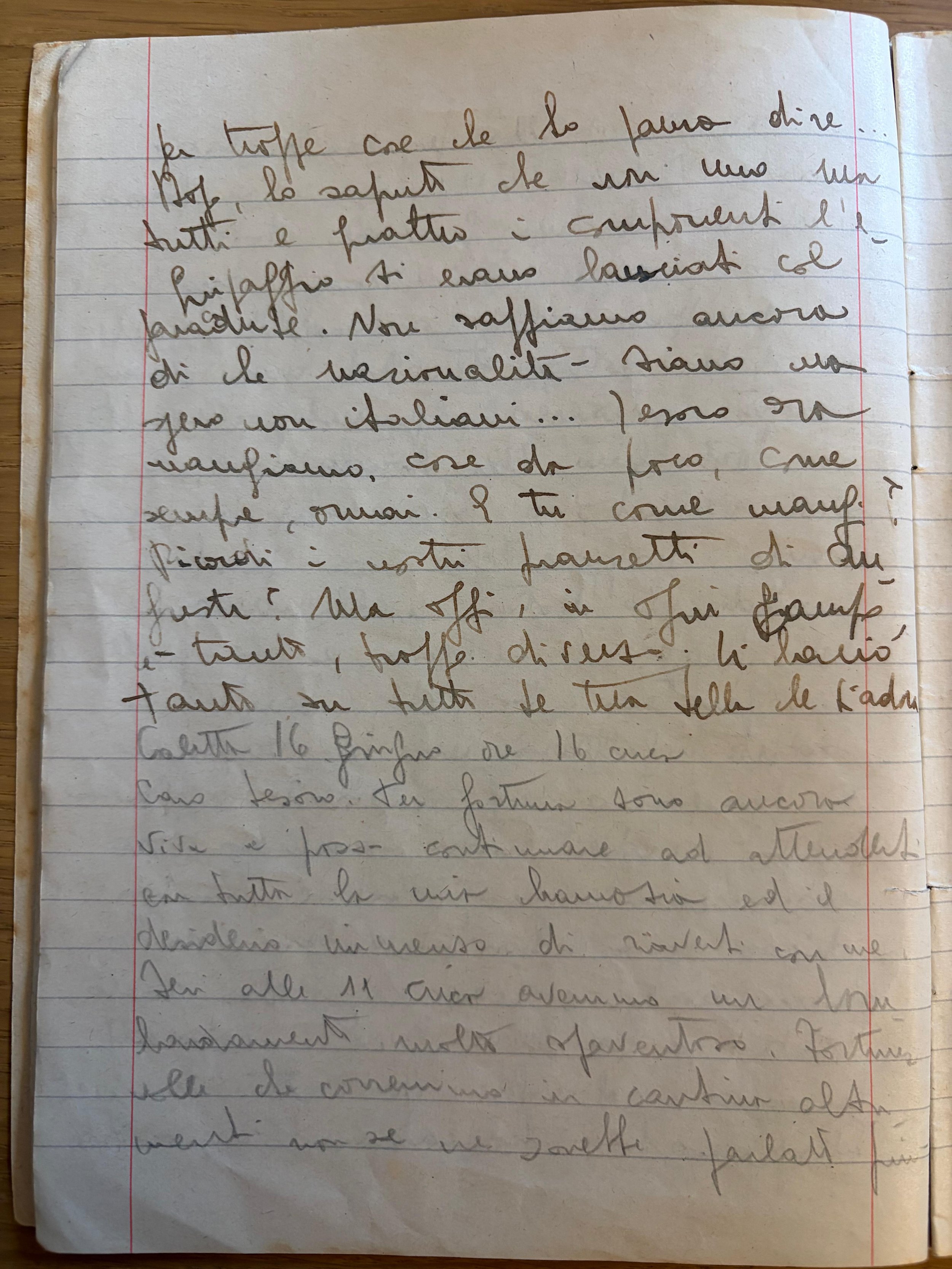
DIARIO 3. 16 Giugno 1944, 11am.“Ancora viva”
[ITA]
[Castiglioncello]. Caro tesoro. Per fortuna sono ancora viva e posso continuare ad attenderti con tutta la mia bramosia ed il desiderio immenso di averti con me. Ieri alle 11 circa avemmo un bombardamento molto spaventoso. Fortuna volle che corremmo in cantina velocemente. Ma l’altro ieri alcuni caccia bombardieri nei pressi del ponte a destra di casa mia, naturalmente senza colpirlo, e così ci spaventammo tanto sai, vidi gli apparecchi buttarsi in picchiata su di noi bassissimi, sganciarono proprio sopra di noi. Immagina che la base di una bomba è stata trovata nel giardino accanto! Io, scalza, mi buttai a precipizio per le scale e con me mamma, ci sdraiammo in fondo, e appena scoppiarono le bombe i sassi venivano da tutte le parti!
Questa, forse, la nostra fortuna perché rimanemmo tutti impressionati da come era arrivato in cantina, anche con un solo colpo, e così quando vidi la formazione, via a corsa in cantina, tanto più che i primi sei erano 36 bombardieri, arrivati verso Castiglioncello, si sono allargati ed ho avuto proprio la convinzione di quello che poi è accaduto. Ero appena arrivata in cantina che sento sganciare… Mi butto in terra, sembrava che la casa dovesse venirci addosso. Dalla finestrina e dalla porta, sassi e polvere entravano da far asfissiare. Ho urlato tanto mentre bombardavano, sarebbe stato orribile morire senza rivederti, poi mi è preso come un che di nervoso, sono andata a casa la quale era un po’ danneggiata, vetri rotti, finestre sgangherate e qualche crepa, ho messo da parte la mia roba in un sacco e in una valigia, e con mamma, babbo e la famiglia di Tatiana ci siamo messi in cammino per la campagna. Che desolazione a Caletta, Mario! Hanno colpito Portovecchio, quante case buttate giù e quante morti, anche di nostra conoscenza! Quale tristezza! Meno male siamo salvi! Ho scritto un rigo a Populonia, poverini come staranno in pensiero per me!
Abbiamo per pura fortuna trovato un rifugio. Abbiamo portato le matereasse e qualche cosa per mangiare. Preferisco tutti questi disagi anziché stare allo spavento! Del resto ognuno a Caletta la pensa così perché è rimasta deserta. Stamani nuovo spavento. Una forte formazione ha girato tante volte qui sopra, poi ha sganciato un monte di bombe a Castiglioncello, a quel ponte che hanno centrato! Che paura, ho ancora il mal di stomaco, mi ero sdraiata in rifugio, con un cuscino in testa. Ma ormai questi patimenti saranno per poco. Dice che stanotte gli Inglesi hanno sbarcato a Porto Ferraio. La Quinta Armata sta avanzando da Follonica e fra qualche giorno spero di ritornare a casa e porre fine a questo stato di cose che mi hanno ridotto ad un cencio.
A Roma, dopo 7 giorni di occupazione, hanno riattivato la posta come anche nell’Italia meridionale, spero sarà così anche qui e così tra pochissimo potrò avere ciò che da 10 mesi passati aspetto con tutta l’ansia del mio cuore.
I contadini qui intorni hanno detto che stanotte non andranno a letto per aspettare gli Inglesi, io penso che sia ancora troppo presto, in ogni caso amore ti confesso che ora che sta per riattivare la posta mi sento addosso una speranza…. scriverai subito, quando gli altri?…che paura!! Spero di rivderti tra pochi giorni! Questo pensiero mi sconvolge e mi tormenta, sarebbe troppo per me abituata così… Mi basta un rigo, una firma, Mario… ma avrò tanta grazia? Non morirò prima? Certo, la parola dell’invasione alle porte mi sconvolge. Quanto resisteranno i Tedeschi? Bombarderanno dal mare? Beato chi lo racconterà.
Per stasera ti lascio, sono stanca, due notti in bianco e mi duole la testa. Ti mando un bacione sulla bocca, come vorrei dartelo in realtà…
___________
Il racconto di Nonna avviene all’indomani di un giorno di guerra terribile per Castiglioncello e i paesi vicini. Come riportato dal sito LungomareCastiglioncello:
“Tra le ore 8.27 e le ore 8.37 del 15 giugno 1944 trentotto bimotori North American B-25 Mitchell del 321st Bombardment Group inquadrato nella 12th Air Force statunitense, decollarono da Solenzara in Corsica per andare a bombardare un viadotto a Ronta in Provincia di Firenze. Gli obiettivi alternativi previsti per quel giorno, erano il ponte ferroviario e il vicino ponte stradale presenti a Castiglioncello, in località Caletta. Trovato l’obiettivo primario occultato dalle nuvole, i trentotto aerei suddivisi in due formazioni di diciannove velivoli ciascuna, si diressero verso Castiglioncello. Arrivati nei pressi dell’obiettivo stabilito, la prima formazione - con direzione ovest/sud –ovest - si trovò sulla rotta corretta per colpire i ponti previsti, e alle 10.47 sganciò, dalla quota di 10.000 piedi (circa 3000 metri), settantasei bombe da 1000 libbre (circa 450kg). L’altra formazione, invece, si trovò su una rotta errata per colpire i ponti, e arrivata sopra Rosignano Solvay, nonostante non ci fossero obiettivi importanti da colpire, alle 10.47 sganciò, sempre dalla quota di 10.000 piedi, alcune bombe da 1000 libbre nella zona nord del paese. Come testimoniano le relazioni degli equipaggi, il tiro non fu accurato. La percentuale di precisione rispetto all’“area bombing” prevista, fu del 41%. Il ponte della ferrovia fu colpito, quello stradale no. Furono però colpite numerose abitazioni a Caletta e a Portovecchio di Castiglioncello. Il primo edificio a essere distrutto fu l’Istituto Israelitico Levi in località Trich Troy, a Caletta, dove perirono numerose persone molte delle quali sfollati, lì giunti alla ricerca di un luogo sicuro in mezzo alla campagna. Furono colpite e distrutte anche la Scuola Fucini di Castiglioncello, Villa Marina (in quel momento sede della Todt ovvero dell’impresa che si occupava della costruzione di strade, ponti e opere difensive per l’esercito tedesco) nella quale perirono due civili italiani e tre soldati tedeschi. Fu gravemente danneggiata anche la Chiesa di Portovecchio, dove rimase ferito il parroco Don Carlo Gradi. A Rosignano Solvay furono colpite abitazioni lungo la via Aurelia, in via Monte alla Rena, in via del Fascio (ora via del Partigiano) e in via Dino Leoni (ora via Enrico Berlinguer). Il prezzo in vite umane pagato dalla popolazione fu molto elevato. I caduti civili furono in totale 35, dei quali 19 nel crollo dell’Istituto Israelitico Levi e nelle abitazioni in Località Casalino; 2 nel crollo di Villa Marina; 8 nelle abitazioni e nelle strade di Caletta e Portovecchio di Castiglioncello; 6 a Rosignano Solvay” https://www.lungomarecastiglioncello.it/CASTIGLIONCELLO/CRONACHE/~Indice_Cronacheind.htm )
[EN] “Still Alive”
[Castiglioncello]. My dear love. Fortunately, I am still alive and can continue to wait for you with all my longing and the immense desire to have you with me. Yesterday, around eleven, we endured a very frightening bombing. Luckily, we managed to run quickly into the cellar. But the day before yesterday some fighter-bombers attacked near the bridge to the right of my house, of course without hitting it, and we were terribly frightened. I saw the planes dive down on us, flying extremely low; they released their bombs right above us. Imagine that the base of a bomb was found in the garden next door! Barefoot, I hurled myself down the stairs, with Mama beside me, and we lay flat at the bottom; as soon as the bombs exploded, stones were flying everywhere!
This was perhaps our good fortune, because we were all deeply shaken by how even a single strike could reach the cellar. So when I saw the formation yesterday, we ran straight to the cellar again, especially since the first six planes, thirty-six bombers in all, arrived over Castiglioncello, then spread out, and I had a clear sense of what was about to happen. I had just reached the cellar when I heard the bombs being released… I threw myself to the ground; it felt as if the house was about to collapse on us. Through the small window and the door, stones and dust poured in, almost suffocating us. I screamed the whole time they were bombing…it would have been horrible to die without seeing you again. Then something like a nervous shock came over me. I went back upstairs: the house was damaged…broken glass, shattered windows, and a few cracks. I gathered my belongings into a sack and a suitcase, and with Mama, Papa, and Tatiana’s family, we set off into the countryside.
What devastation in Caletta, Mario! They hit Portovecchio…so many houses destroyed and so many dead, including people we knew. Such sadness! Thank goodness we are alive. I wrote a few lines to Populonia, poor souls, how worried they must be about me!
By sheer luck we found a shelter. We brought mattresses and a little food. I prefer all these hardships to living in constant terror. In fact, everyone in La Caletta feels the same, because it has been completely abandoned. This morning there was another fright. A large formation circled overhead many times, then dropped an enormous number of bombs on Castiglioncello, on that bridge, which they finally hit! Such fear; my stomach still hurts. I lay in the shelter with a cushion over my head. But these sufferings should soon be over. They say that last night the British landed at Portoferraio. The Fifth Army is advancing from Follonica, and in a few days I hope to return home and put an end to this state of things that has reduced me to a rag.
In Rome, after seven days of occupation, the postal service has been restored, as it has in southern Italy. I hope it will be the same here, and that very soon I will receive what I have been waiting for, with all the anxiety of my heart, for the past ten months.
The farmers around here say they will not go to bed tonight, waiting for the British. I think it is still too soon, but in any case, my love, I confess that now, with the post about to resume, I feel hope upon me… Will you write immediately, like the others?… How frightening!! I hope to see you again in a few days! This thought overwhelms and torments me; it would be too much for me, after becoming so used to this waiting… A single line is enough, a signature, Mario… but will I be granted such grace? Will I die before then? Of course, the thought of the invasion at the gates shakes me deeply. How long will the Germans resist? Will they bombard from the sea? Blessed is whoever will live to tell it.
For tonight I leave you, I am tired…two sleepless nights, and my head aches. I send you a kiss on the mouth, as I wish I could give it to you in reality…
___________
Nonna’s account takes place in the aftermath of a terrible day of war for Castiglioncello and the surrounding towns. As reported by the website LungomareCastiglioncello:
“Between 8:27 and 8:37 a.m. on 15 June 1944, thirty-eight North American B-25 Mitchell twin-engine bombers of the 321st Bombardment Group, part of the U.S. 12th Air Force, took off from Solenzara in Corsica to bomb a viaduct in Ronta, in the province of Florence. The alternative targets planned for that day were the railway bridge and the nearby road bridge located in Castiglioncello, in the Caletta area. When the primary target was found to be concealed by clouds, the thirty-eight aircraft, divided into two formations of nineteen planes each, headed toward Castiglioncello.
Upon reaching the vicinity of the designated target, the first formation, approaching from a west/south-west direction, found itself on the correct route to strike the intended bridges and, at 10:47 a.m., dropped seventy-six 1,000-pound bombs (approximately 450 kg) from an altitude of 10,000 feet (about 3,000 metres). The other formation, however, was on an incorrect route to hit the bridges and, upon reaching Rosignano Solvay, despite the absence of significant military targets, also at 10:47 a.m. released several 1,000-pound bombs from the same altitude over the northern area of the town.
As testified in the crews’ reports, the bombing was inaccurate. The level of accuracy with respect to the planned ‘area bombing’ was 41%. The railway bridge was hit; the road bridge was not. However, numerous homes in Caletta and in Portovecchio di Castiglioncello were struck. The first building to be destroyed was the Levi Jewish Institute in the Trich Troy area of Caletta, where many people were killed, many of them evacuees who had sought refuge there in the countryside in search of safety.
The Fucini School in Castiglioncello was also hit and destroyed, as was Villa Marina (at that time headquarters of the Todt Organization, the company responsible for building roads, bridges, and defensive works for the German army), where two Italian civilians and three German soldiers were killed. The Church of Portovecchio was also severely damaged, and the parish priest, Don Carlo Gradi, was injured.
In Rosignano Solvay, homes were hit along Via Aurelia, Via Monte alla Rena, Via del Fascio (now Via del Partigiano), and Via Dino Leoni (now Via Enrico Berlinguer). The human cost paid by the civilian population was extremely high. Civilian casualties totalled thirty-five: nineteen died in the collapse of the Levi Jewish Institute and in homes in the Casalino area; two in the collapse of Villa Marina; eight in homes and streets in Caletta and Portovecchio di Castiglioncello; and six in Rosignano Solvay.” https://www.lungomarecastiglioncello.it/CASTIGLIONCELLO/CRONACHE/~Indice_Cronacheind.htm )