DIARIO 1. 8 Dicembre 1943. “Dei 15.000 che siete in Sardegna“
[ITA]
[Castiglioncello]. Dopo molti giorni ti scrivo ancora. Giorni passati ugualmente tristi e senza speranza. Ormai sono scoraggiata e non ho più la forza di andare avanti. Menomale che ogni tanto qualcuno mi dice di avere un suo caro in Sardegna e di essere priva di notizie.
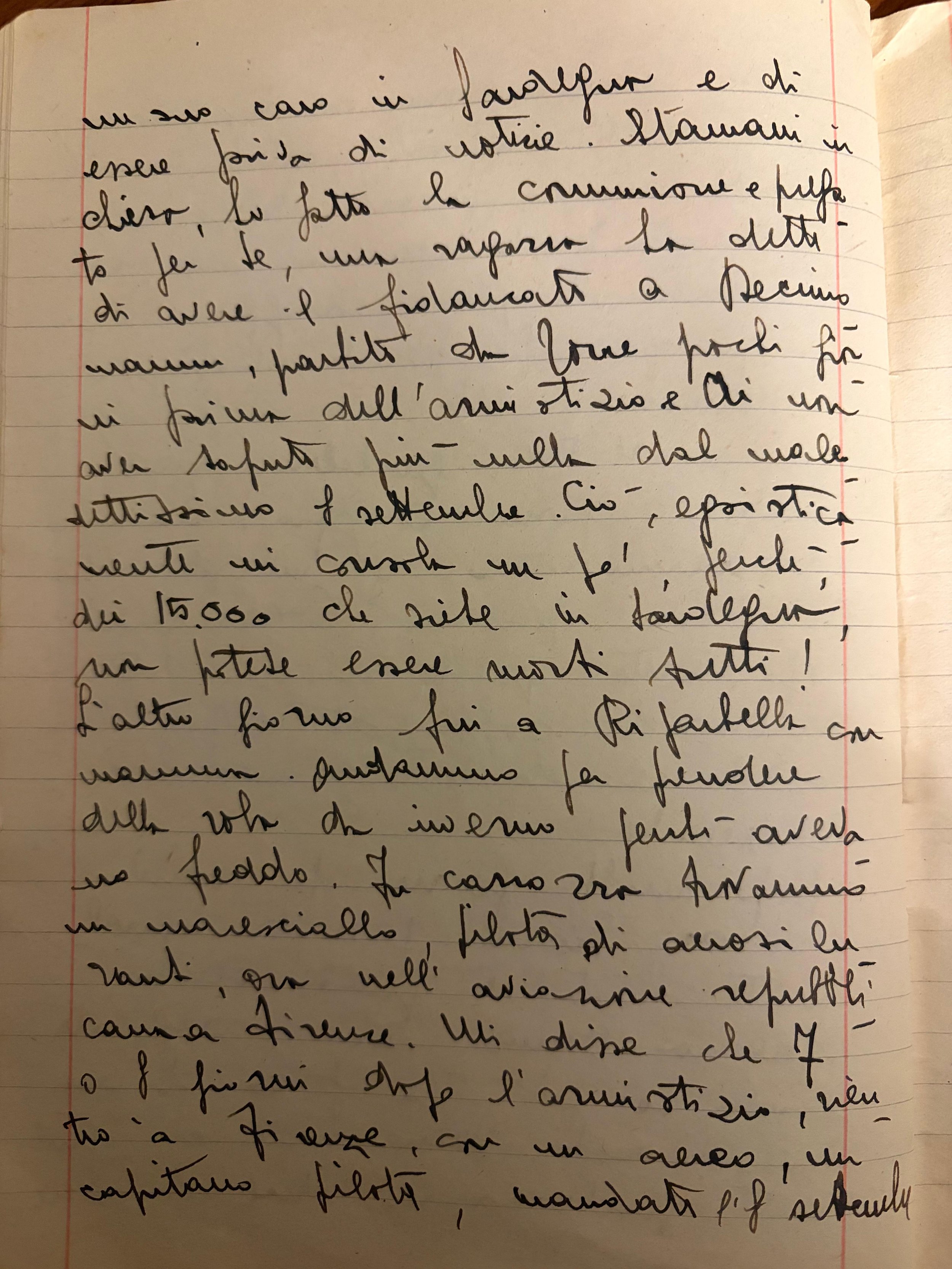
Stamani in chiesa, ho fatto la Comunione e pregato per te, una ragazza ha detto di avere il fidanzato a Decimomannu [in Sardegna], partito da Torre pochi giorni prima dell’Armistizio e di non aver saputo più nulla dal maledettissimo 8 Settembre. Ciò egoisticamente mi consola un pò, perché dei 15.000 che siete in Sardegna non potete essere morti tutti!
L’altro giorno fui a Riparbella. Andammo per prendere della roba da inverno perché avevamo freddo. In carrozza trovammo un maresciallo, pilota dell’Aviazione Repubblicana a Firenze. Mi disse che 7 o 8 giorni dopo l’Armistizio, rientrò a Firenze, con un aereo, un capitano pilota, mandato l’8 Settembre come te a Elmas [in Sardegna]. Non mi ha saputo dire molto di costà perciò ho scritto a questo capitano e se sarà il caso andrò anche a parlarci.
Credimi, faccio di tutto, parlo con tutti, ma per ora tutto e’ stato inutile.
L’altro giorno in stazione con mamma, parlammo con un signore in borghese, che era e anzi è tutt’ora un’Ufficiale di Marina agli ordini Tedeschi. Dice di un suo amico carissimo che era aviatore in Sardegna, ha avuto notizie mediante un suo comandante che è prigioniero in Polonia. Gli ho dato tutti i tuoi dati e mi ha detto che si interesserà subito.
A Cecina, cioè al ponte di Cecina, trovammo tua mamma che andava all’Ardenza [città natale di Nonno, vicino Livorno] e cosi abbiamo aspettato il treno insieme. Abbiamo fatto del fuoco, ma certo si gelava. Sai, hanno tirato per la terza volta sul ponte, e questa volta l’hanno centrato in pieno: ci sono rimasti i piedi e lesionati i pilastri, ma dicono che col tempo riattiveranno la linea mettendoci un ponte di ferro. Per ora il trasbordo non è troppo disagevole, si passa dal ponte della strada, ma se colpiscono anche quello? Tua mamma tornò ad Ardenza la sera, e dormì e mangiò qua, poi la mattina alle 4 partì per Populonia.
Stamani ho sentito un rumore che mi piaceva poco: mi sono affacciata in terrazza e ho veduto sopra la mia testa due caccia, bassissimi, sfioravano i pini della Signora Recanati. Con delle croci rosse, con dei ghirighori, ho pensato subito che non erano Tedeschi. Infatti ora ho saputo essere stati Americani ed aver mitragliato un treno che usciva dal tunnel, incendiando la macchina. Scaramucce all’ordine del giorno ormai. E Lella che non ci fa neppure tanto caso, viviamo del minuto sapendo che prima o poi toccherà anche a noi.
Stanotte andrò con mamma a Torre a prendere i tuoi stivali e a chiedere notizie a qualche famiglia che è ancora là. Speriamo di tornare. Ci vado volentieri, con la speranza di sapere qualcosa di te o degli altri che sono con te. E’ inutile dire che il mio pensiero è a te e che ti adoro troppo. Ormai non so a che punto sono arrivata e ogni giorno che passa vedo sempre di più la nullità della mia vita lontana da te. Ormai sono sfortunata, ma spero che non lo sarò per molto altro. Almeno dal Vaticano tra un mese o due saprò qualcosa. Diminuisco fino da ora i giorni. Ma c’è da sbagliarsi. Sono 30 o 60? E pensare che mi sembrava d’impazzire quando si trattava di 6 o 7 giorni! Così è il mondo.
Ora ti lascio con un bacione nella bocca. Ti scrivo a Populonia.
[EN] “You and the 15.000 in Sardinia”
[Castiglioncello]. After many days, I am writing to you again. These days have passed in the same sadness and without hope. By now I feel discouraged and no longer have the strength to go on. At least, from time to time, someone tells me they too have a loved one in Sardinia and have received no news.
This morning at church, after receiving Communion and praying for you, a young woman said her fiancé is in Decimomannu [in Sardinia] having left Torre a few days before the Armistice, and that she too has had no news since that cursed 8 September. Selfishly, this comforts me a little, because of the 15,000 of you in Sardinia, you surely cannot all be dead!
The other day I went to Riparbella. We went to collect some winter clothes because we were cold. In the carriage we met a marshal, a pilot of the Republican Air Force stationed in Florence. He told me that seven or eight days after the Armistice he returned to Florence by plane, together with a captain pilot who had been sent on 8 September, like you, to Elmas [in Sardinia]. He could not tell me much about conditions there, so I wrote to this captain, and if necessary I will go and speak to him in person.
Believe me, I am doing everything I can, I speak to everyone, but so far everything has been in vain.
The other day at the station with Mum, we spoke with a man in civilian clothes who was, and still is, a naval officer under German command. He spoke of a very dear friend of his, an aviator in Sardinia, from whom he received news through a commander who is now a prisoner in Poland. I gave him all your details, and he told me he would look into it immediately.
In Cecina, by the bridge, we met your mother on her way to Ardenza [Nonno’s birthplace, near Livorno], and we waited for the train together. We made a small fire, but it was terribly cold. You know, they have shelled the bridge for the third time, and this time they hit it squarely: the decking is gone and the pillars are damaged, but they say that in time they will reopen the line by installing an iron bridge. For now the transfer is not too uncomfortable; people cross over the road bridge, but what if they hit that one too? Your mother returned to Ardenza that evening, slept and ate here, then left at four in the morning for Populonia.
This morning I heard a sound I did not like: I stepped out onto the terrace and saw two fighter planes directly above my head, flying really low, skimming the pine trees of Signora Recanati. They bore red crosses, with markings, and I immediately thought they were not German. In fact, I have since learned they were American, and that they machine-gunned a train emerging from the tunnel, setting the engine on fire. Skirmishes are now the order of the day. And Lella hardly even notices anymore; we live minute by minute, knowing that sooner or later it will be our turn too.
Tonight I will go with mamma to Torre to collect your boots and to ask for news from any families still there. Let us hope we return. I go willingly, with the hope of learning something about you or the others who are with you. It is useless to say that my thoughts are with you and that I adore you beyond measure. I no longer know what state I am in, and with each passing day I see ever more clearly the emptiness of my life without you. I am unlucky now, but I hope not for much longer. At least from the Vatican, in a month or two, I will know something. I am already counting the days down, though I may be mistaken. Is it thirty or sixty? And to think that I felt I was going mad when it was only six or seven days! Such is the world.
Now I leave you with a kiss on your lips. I will write to you from Populonia.